 Pat Taub
This past weekend, I attended a screening of Earth’s Greatest Enemy, Abby Martin’s jarring documentary, exposing how the US Military has become the world’s biggest polluter.

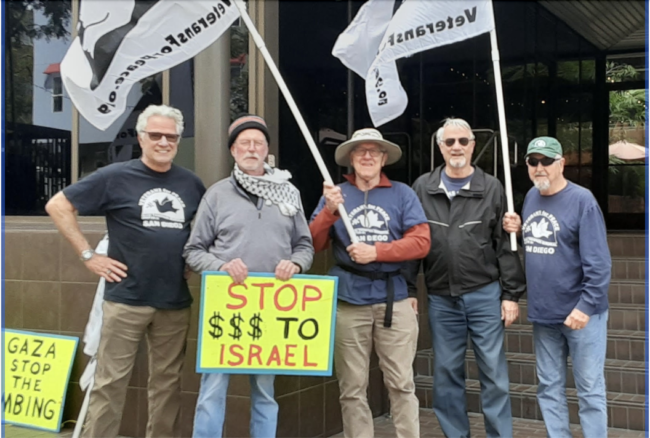
In the small, funky Brunswick, Maine theater, with admiration and certainly some nostalgia, I connected again with individuals who’d carried and continue to carry banners that urge all civilized people to end war:
Members of Vets for Peace, 50 years later still suffering from the ravages of serving in Viet Nam; women in their senior years who came of age during the Second Wave of Feminism, championing abortion rights, equal pay for women, and anti-discrimination in sports and the workplace; “Third Act Maine,” elders and climate activists, pointing out the devastation of fossil fuel dependency, advocating for clean energy policies.
The film rolled; we gasped at one chilling image after another: soldiers in a desert methodically lining up and igniting unused bombs—the skies transformed into fiery orange and filled with dangerous chemicals; military bases where the waters are so toxic that generations are experiencing cancer and birth defects; in Okinawa and Hawaii where terrain is sandblasted, destroyed to create landfills, endangering marine life in the process.
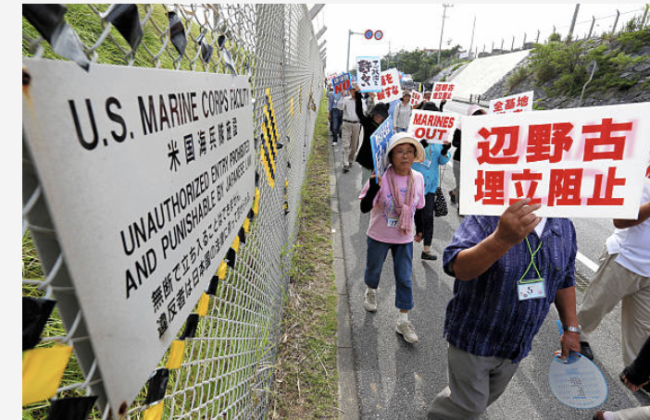
Residents of Okinawa protesting against the US military’s presence
Earth’s Greatest Enemy had shaken me; I slipped for a long moment into hopelessness. What brought me around? The unstoppable voices and works of elder activists, who continue to care, whom I know.
Driving home I recalled a few of these gifted, committed remarkable individuals:
P: Former Viet Nam nurse and member of Vets for Peace, a regular at Saturday protests supporting Gaza, and frequent nurse volunteer at community immunization clinics. Recipient of numerous local peace awards for her volunteer contributions.
S: Long-time supporter of Palestine, joining numerous volunteer trips to Palestine to pick olives during the olive harvest; fund raiser for families in Gaza struggling to survive during the on-going genocide.
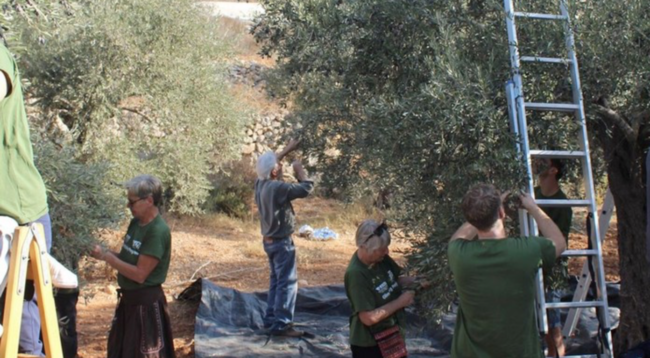
American volunteers picking olives in Palestine
C: Retired civil liberties attorney, volunteer for the ACLU and National Lawyers Defense League and regular voice for peace and justice causes. At 83 his commitment is tireless.
T: Quaker and decades-long volunteer at the Quaker school in Ramallah in Palestine’s West Bank. Instrumental in educational exchanges between students in Ramallah and the US, while leading fundraisers for the school.
J: Early member of Codepink, the women’s peace group founded in 2002 to protest America’s invasion of Iraq. Regularly joins Codepink actions, contributing to their newsletter. Active with her chapter of Vets for Peace, organizing virtual meetings and writing for their publication.

A recent Codepink action in DC in support of Gaza
M: Born in Latin America, migrating to the US as a young woman, now a naturalized citizen. During the ICE raids she organized programs for families targeted by ICE; recently heading efforts to raise money for Cuba.
G: At 91, G has a long history working to gain legislative rights for low-income families, along with peace and justice causes; an inveterate writer of letters to the editor. A legend in her community,
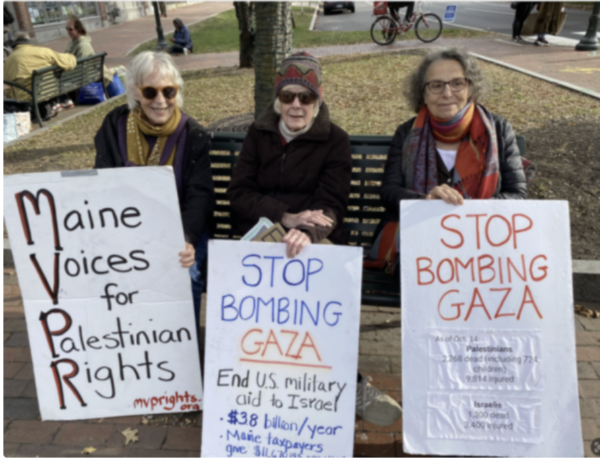
Elders can be activists. Those unable to stand in protests, take to a park bench with protest signs. Zoom meetings and phone banks make activism from home possible.
Age doesn’t diminish their courage. Frequently, older activists are among those arrested in peaceful civil disobedience actions. Pro-Palestine demonstrations in the UK–more than 500 were arrested– included a large number of elders, many frail, some in wheelchairs.
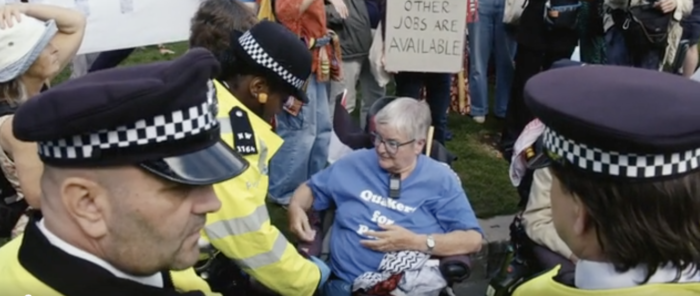
Wheel-chaired elder arrested last year at a Pro-Palestine rally in London–her shirt reads “Quaker for Peace”
