 Pat Taub
Count me among the countless fans and admirers of Diane Keaton who were shocked and saddened by her sudden death on October 11th. Her wide-ranging movie roles—from Woody Allen’s comedic sidekick to the tormented protagonist of “Mr. Goodbar” to the fiery journalist, Louise Bryant in “Reds”–along with her off screen life as an independent woman who aged gracefully with humor and a zest for life will be forever carved in my memory.
An early memory of Keaton is as the loveable kook, Annie Hall, in Woody Allen’s film with the same title. Like so many other women who saw the film, I adopted Annie’s attire of men’s ties, oxford shoes and bulky trousers, frequently showing up for work in my husband’s ties and one of his tweed jackets.
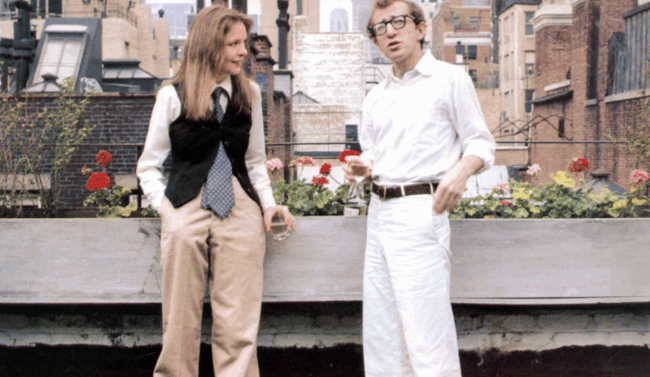
Diane Keaton and Woody Allen in Annie Hall (1977)
During this period, I was working as a counselor at a small private college in upstate New York. One evening I attended a reception for faculty and staff at the President’s home. Looking around I noticed the President and I were the only ones wearing ties. I shared my observation with him, thinking he would find it amusing. Instead, his eyebrows went up, and he abruptly turned to another colleague.
I was moved by Keaton’s deep love for her adopted children and her close friends. But for me, she went a step too far when she vigorously defended Woody Allen against charges of molesting his stepdaughter.
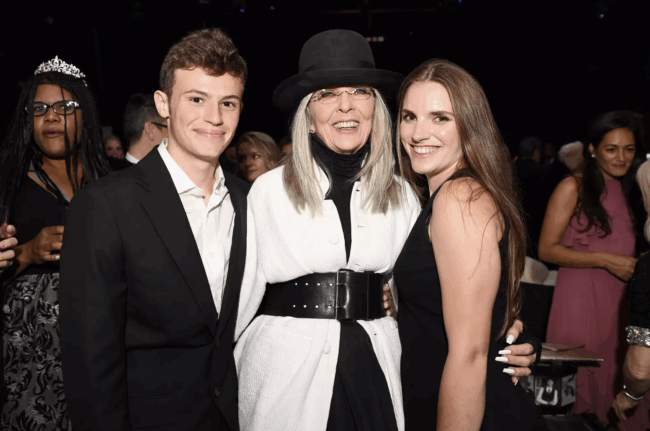
Diane Keaton with her adopted children, Duke and Dexter, (2019)
Over and over mournful colleagues in the entertainment industry have commented on Keaton’s openness and lack of pretense. She was a singular figure in an industry dominated by temperamental entitled stars.
Diane defied the trend among big stars when she rejected plastic surgery. In an interview with Terry Gross on “Fresh Air,” she explained why she eschewed plastic surgery:
“How can you be an authentic character? I mean, how can you be a real woman age 60 playing a part of a woman, let’s say, in the South who’s naive and doesn’t know a lot? How can you play that part if you’ve had a face-lift? You can’t.”
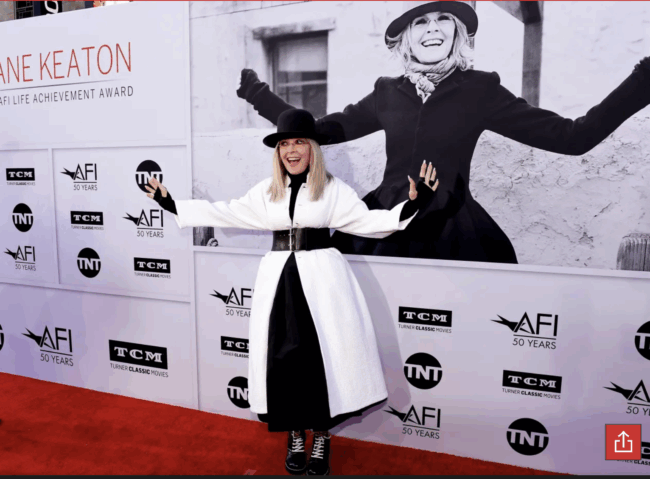
Diane Keaton arrives at the American Film Institute, where she received the 45th Life Achievement Award, 2017.
In another comment on aging, made during a break filming “Hampstead,” (2017), Keaton, playing an older woman, reflected: “I was just thinking how strange it feels when the world stops needing you — and you have to start needing yourself.”
As she aged, her signature comedic roles abandoned Anne Hall’s la-di-da, in favor of more mature characters. In “Something’s Gotta Give” opposite Jack Nicholson, Keaton projects her zany, self-effacing side which, over the course of the film, is overshadowed by her resilience. When her character of Erika is rejected by Nicholson’s Harry, Erika sobs for days, before burying herself in her work as a playwright, and moving on. As befitting a romantic movie, there is a happy ending when the Nicholson character, after some soul-searching, climbs off his macho pedestal, and humbled seeks out Erika.
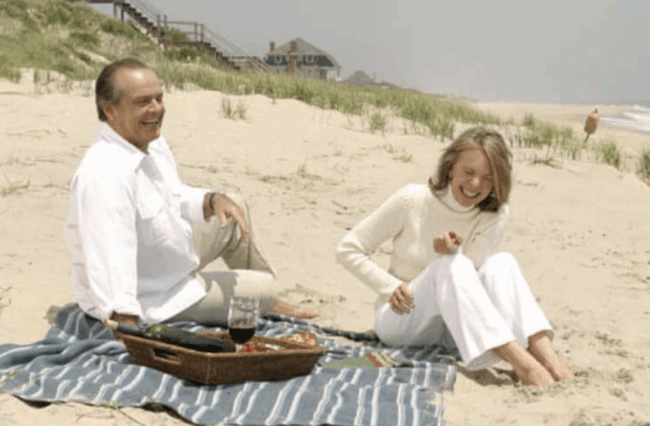
Jack Nicholson and Diane Keaton in Something’s Gotta Give (2003).
In real life, a confessional refrain in Keaton’s interviews with the likes of Charlie Rose and Ellen, was that she hadn’t been asked out on a date in years. She never seemed bitter or angry at these times but accepting of her lot.
Off screen Diane Keaton was an advocate for mental health, while campaigning to protect wildlife, preserve architectural history and grant LGBTQ+ rights. She was an accomplished photographer, publishing four books of photographs.
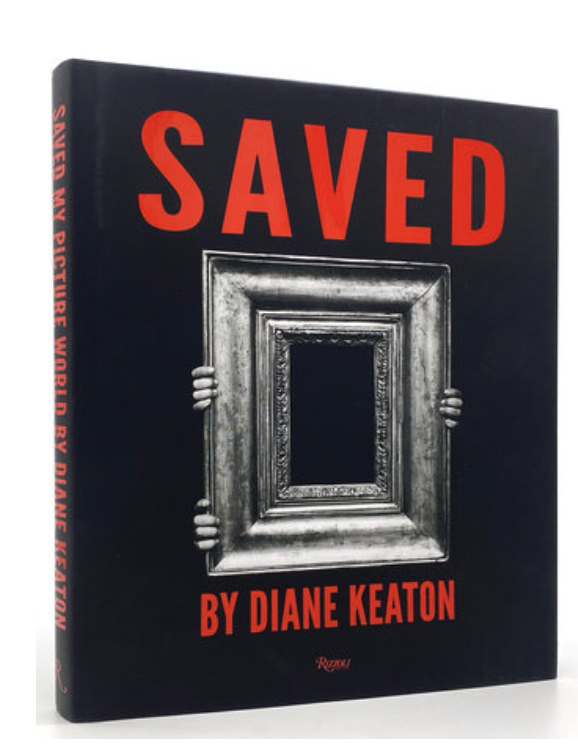
Keaton’s last book of photos, taken from her personal collections (2022)
Diane Keaton has left us, but her gifts can live on. We can embrace her commitment to aging naturally; to being content with who we are; to supporting family and close friends; to approaching the world with curiosity, and never, ever forgetting to laugh.
